Antonin Fourneau

Eniagolf

Golf is often associated with privilege: vast, carefully maintained landscapes requiring significant amounts of land and potable water. At times, the sport appears disconnected from the ecological and social realities of our era. It has also become a symbol of political and economic power—from leaders playing while their countries face major crises, to exclusive courses built alongside contested borders, or informal diplomatic meetings held on the fairway. In many ways, golf embodies social distance, both literally and metaphorically.

But what if golf could tell a different story? What if it became a game open to everyone, played in public spaces and shaped by local communities?

Mini-golf already democratizes the practice by making it accessible to people regardless of income. Its reduced scale also encourages imagination: instead of relying on spectacular landscapes, designers invent playful obstacles and unexpected narratives. As a result, mini-golf has become a far richer medium for creative expression than its larger counterpart.

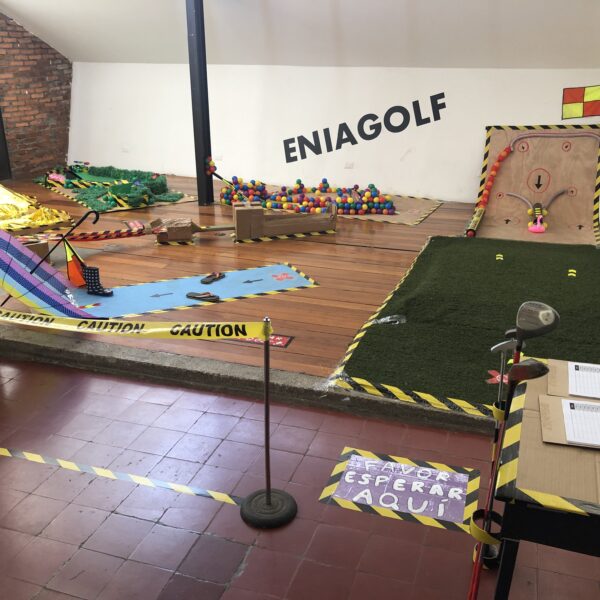
Eniagolf pushes this idea further by providing a toolkit and a set of simple instructions that enable anyone to transform almost any environment into a temporary mini-golf course. Using locally found objects, discarded materials, and everyday urban elements, each course becomes a unique reflection of its context. Rather than consuming new resources, the project invites participants to reinterpret what already exists, turning waste into play and public space into a collective artwork.